

Understanding Apparel Manufacturing Processes: A Comprehensive Guide (2026)
1. Apparel Manufacturing Process: How Does It Work?
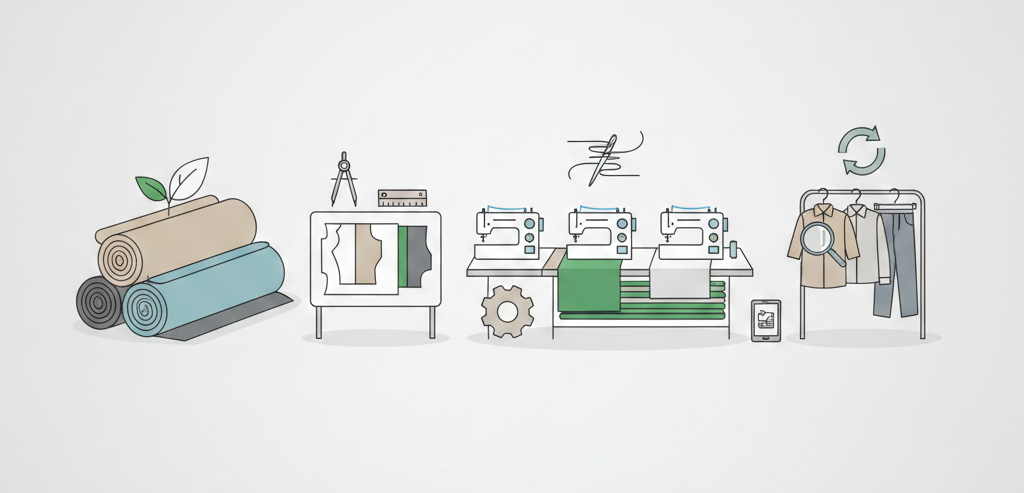
The apparel manufacturing process is a step‑by‑step journey that transforms a designer’s sketch into a ready‑to‑wear garment. In Bangladesh—one of the world’s most efficient garment hubs—this workflow is honed for speed, quality, and cost‑effectiveness.
Understanding each stage helps you appreciate the craftsmanship behind your favorite t‑shirts, jeans, and dresses, and it also reveals where sustainability and ethical practices can make the biggest impact.
2. Design & Product Development
What Happens?
- Concept Sketches: Designers draft hand‑drawn or digital illustrations.
- Tech Packs: Detailed documents (measurements, stitch types, trims) are created for manufacturers.
- Prototype Samples: Sample rooms produce a first‑sample (often called a “proto”) to test fit, drape, and aesthetics.
Why It Matters: A solid design foundation reduces re‑work later, cuts costs, and speeds up time‑to‑market. Brands that invest in digital design tools (e.g., CLO 3D, Adobe Illustrator) see up to 30% faster sample approvals.
3. Material Sourcing & Procurement
| Material | Typical Sources | Key Considerations |
|---|---|---|
| Fabrics (cotton, polyester, blends) | Local mills, overseas suppliers | GSM, shrinkage, sustainability certifications (e.g., GOTS) |
| Trims (buttons, zippers, labels) | Specialized trim houses | Durability, color matching, cost |
| Auxiliaries (thread, interfacing) | Bulk distributors | Tensile strength, colorfastness |
Sustainability Angle: Brands increasingly demand organic cotton, recycled polyester, and water‑less dyeing—a shift that influences supplier selection and cost structures.
4. Pattern Making & Grading
Pattern Making: Translating a 2‑D sketch into a precise paper or digital template that guides cutting.
Grading: Scaling the base pattern to create size ranges (XS‑XXL, etc.).
Tools & Technology
- Manual: Drafting tables, pattern paper.
- Digital: Gerber AccuMark, Lectra, Optitex—allow instant adjustments and automatic grading.
5. Cutting & Pre‑Production
| Method | Advantages | Typical Use |
|---|---|---|
| Manual Cutting | Low capital cost | Small‑batch, high‑style garments |
| Straight-knife | Fast, low waste | Mid‑volume production |
| Laser Cutting | Precise, minimal fray | Technical fabrics, intricate shapes |
| CNC / CAD‑Cutter | 99% material utilization | Large‑scale factories (e.g., Bangladesh) |
Pre‑Production Steps
- Marker Making: Arranging pattern pieces to maximize fabric yield.
- Bundling & Sorting: Grouping cut pieces per size/color.
- Inspection: Verifying cut accuracy before sewing.
6. Sewing & Assembly
Cut‑to‑sew line: Pieces flow from cutting directly to sewing stations.
Work‑stations: Each operator handles a specific operation (e.g., shoulder stitching, sleeve attachment).
Key Metrics
- SMV (Standard Minute Value): Time required for each operation.
- Throughput: Garments per hour per line.
7. Finishing & Quality Control
Finishing Techniques
Pressing, ironing, edge treatments (over-lock), and attachment of branding labels.
Quality Control Layers
In-process spot checks, end-line full inspections, and third-party audits for safety.
AQL (Acceptable Quality Level): We typically maintain an AQL of 2.5 for critical defects to ensure consistent quality for global brands.
8. Packaging & Logistics
Packaging options include lightweight poly‑bags (PE, OPP) or eco‑friendly biodegradable bags and recycled cardboard.
Logistics Flow: Warehouse Staging → Load Planning (LCL vs FCL) → Customs Clearance → Last‑mile Delivery.
9. Compliance & Sustainability
| Area | Standard | Why It Matters |
|---|---|---|
| Labor Rights | BSCI, WRAP | Safe wages, working hours, child‑labour free. |
| Environmental | ISO 14001, GOTS | Reduce water usage, chemical waste. |
| Product Safety | CPSIA, REACH | Limits on hazardous substances. |
Sustainable Practices Gaining Traction (2026): Closed‑Loop Water Systems, Circular Fashion (up-cycling), and Renewable Energy integration.
10. The Bottom Line – Why It All Matters
Speed & Cost: Streamlined processes enable collections to launch in under 90 days.
Quality: Rigorous QC at every stage protects brand reputation.
Innovation: Emerging technologies like AI-driven demand forecasting and 3D virtual sampling are reshaping the next decade of fashion.